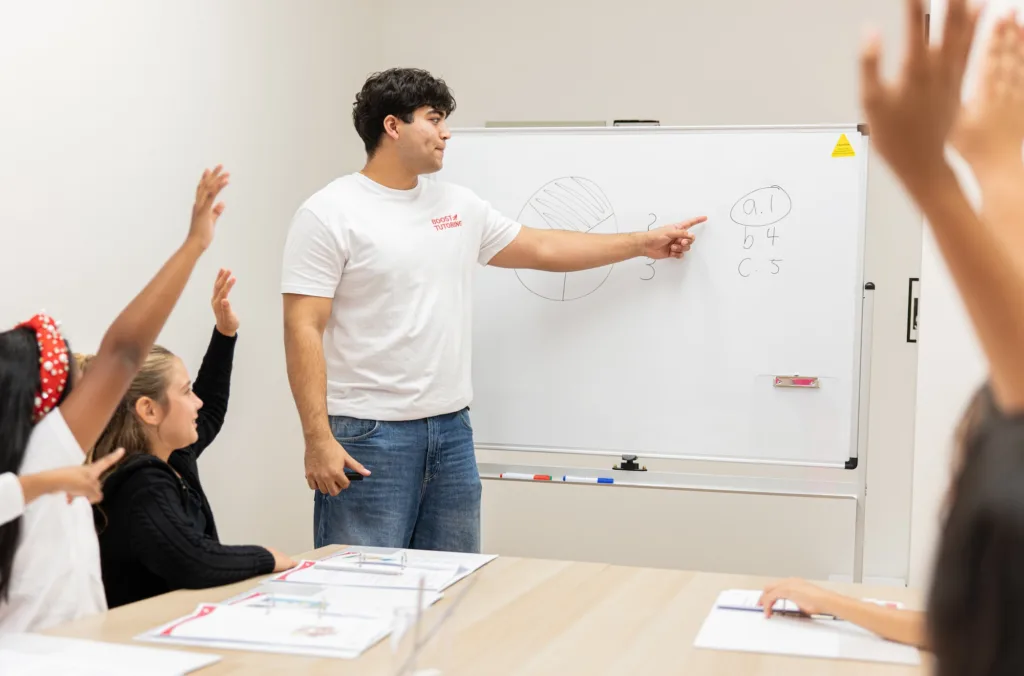
The tricky part isn’t finding a tutor. It’s finding one who can tell you, specifically, which skill your child is missing. A good primary English tutor Castle Hill families rely on starts there, then builds from it.
- Decoding, fluency, vocabulary, comprehension or spelling — whichever one is the problem
- Complex English tasks divided into steps a child can manage
- Explicit teaching, modelling and guided practice built into every lesson
- Classroom learning reinforced without reworking the same school worksheets
- Progress tracked over time so independent skills can take hold
What Literacy Skills Should Primary English Tutoring Strengthen?
Primary English covers several connected skills. Spelling trouble rarely stays in spelling. By Year 4 or 5, it tends to show up in written answers and reading tasks.
The spelling issue usually had a name by Year 2 or 3. What took longer to notice was how it was quietly pulling down written answers and reading tasks in other subjects.
Reading Fluency, Vocabulary and Comprehension
Five skills sit underneath reading ability, according to the Australian Education Research Organisation. Phonemic awareness and phonics build the foundation; fluency, vocabulary and comprehension develop on top. A gap at any level affects what comes after it.
Some children read fluently in the sense that nothing trips them up. Ask what the passage was about, and there’s a pause. Decoding got them through the page; comprehension didn’t follow.
At primary level, comprehension isn’t about general impressions. A child needs to find where the text makes a claim, identify what backs it up, and put that into their own words without drifting from what the passage said. Not what they assumed it said.
Spelling, Sentence Structure and Written Expression
Written expression is harder than it looks from the outside. A child has to hold an idea, shape it into sentences, keep spelling and punctuation in check, and still land the original thought — all at the same time.
A child can have a clear opinion and still produce a written answer that reads as scattered. Knowing what to say and knowing how to sequence it are separate skills — one doesn’t develop automatically from the other.
How Can a Tutor Help When a Child Is Falling Behind in English?
Extra worksheets don’t help much when nobody’s confirmed which skill the child is actually missing. Practice drills the wrong thing just as readily as the right one. Months can pass that way without the gap shifting at all.
Start with the Skill Causing the Difficulty
On a report card, most English difficulties look roughly the same. The cause behind each one is different, and so is what actually fixes it.
Roughly one in ten Australian students fell short of proficiency benchmarks in 2023, according to ACARA. For a number of those students, nothing on their school report had suggested a problem was developing.
A tutor who tests first can target the gap directly.
Build Skills Through Explicit Teaching and Guided Practice
Before a child tries a skill independently, a tutor models it — talking through each decision as it happens, so the thinking behind the answer is visible, not just the answer itself. The worked example comes before the independent practice. Responsibility shifts across gradually as each step becomes reliable.
Earlier skills get revisited until they hold, rather than being ticked off and left behind. Support eases back once a student manages a step without prompting.
What Should Parents Look for in a Primary English Tutor in Castle Hill?
Two tutors teaching the same subject can look different in practice.
Some children need to close a gap, others are working toward opportunity class placement, and the right fit depends on planning as much as location.
Families weighing options locally can read our parent’s guide to English tutoring in Castle Hill, prepared by the team at our Castle Hill centre.
NSW Curriculum Alignment and Individual Support
Years 3 to 6 have defined focus areas under the NSW Education Standards Authority’s English K–10 syllabus. Oral language, vocabulary and reading fluency sit alongside comprehension, spelling and written text creation.
When tutoring tracks that same framework, a child builds on what the syllabus actually requires. The homework folder doesn’t set the agenda.
Consistent Feedback and Measurable Progress
Progress should be something parents can actually see. An initial assessment tells parents where a child’s literacy actually sits at the start. Every session after that has something real to measure against, rather than a general sense that things feel better or worse.
“Good effort” doesn’t tell a parent much. Knowing a child moved from guessing at unfamiliar words to reading a passage back accurately is something a parent can actually see. A stable weekly routine, paired with adjustments as a child’s needs shift, keeps schoolwork and tutoring pulling in the same direction.
FAQs About Primary English Tutoring in Castle Hill
How do I know whether my primary school child needs English tutoring?
Usually the first sign shows up at homework time, well before the report card. Reading that’s far slower than expected, or writing that stalls quickly, says more than a single term result.
How often should a child attend English tutoring sessions?
Once a week is the common starting point for most primary students. A child working through a specific gap, spelling or comprehension, sometimes needs a slightly higher frequency for a short stretch.
Is primary English tutoring worth it if my child is only slightly behind?
Usually. A small comprehension gap in Year 3 doesn’t announce itself. It tends to shrink into the background until the work gets harder. By Year 5, it tends to show up in science reports and history responses rather than on an English test.
How long does it take to see improvement in reading or writing?
There’s no fixed answer. The skill involved matters, and so does how long it’s been unaddressed. What most parents notice first is something behavioural. A child stops making excuses to avoid reading aloud. Sitting down to write stops being a negotiation.
Should tutoring follow schoolwork or focus on missing foundation skills?
Usually both, in that order. Foundation gaps get addressed first, since they hold back everything built on top, and lessons circle back to current classwork once that base is steadier.
Help Your Child Build Stronger English Skills with Boost Tutoring Australia
If reading has become a reluctant activity or English homework reliably ends in frustration, there’s usually a specific reason. It’s also usually findable.
Boost Tutoring Australia offers a free academic assessment that maps exactly where your child’s literacy sits right now, and what needs attention first. From there, we build sessions around the specific skills your child is missing, in a small group with the same tutor each week.
From there, small-group sessions build the specific skills your child needs, without repeating what already happens at school. A clear picture of where a child’s English skills stand is what makes the next step obvious.
Book a free assessment with a primary English tutor Castle Hill families can rely on, and find out exactly where to start.