
There’s a particular kind of phone call that happens around Year 8 or 9. The child was fine at maths in primary school, good even, and then somewhere in high school it quietly came apart. Marks slipped, confidence went with them, and the parent is left wondering what changed, because nothing obviously did. The child is the same; the maths got harder in a way that caught them out.
This is one of the most common patterns we see, and it’s worth understanding before you go looking for help. Here’s what actually changes in high school maths, why children who were fine suddenly aren’t, and what high school maths tutoring in Castle Hill should be doing about it.
What Changes Between Primary and High School Maths
Primary maths is mostly concrete. Numbers you can picture, operations you can see, problems that connect to real things. A child can get a long way on good number sense and careful work.
High school maths asks for something different. It becomes abstract, and fast. Algebra arrives in Year 7 and never leaves, and it asks a child to work with letters standing for unknown numbers, a genuine shift in how you have to think. The problems get longer and more multi-step. The pace quickens, with more content covered in less time. And the maths stops being a set of separate topics and becomes a chain, where each new idea assumes you’ve got the last one.
For a lot of children, this shift is where maths changes from something they understood to something they’re trying to keep up with. Nothing went wrong with the child. The subject simply started demanding a different kind of thinking, and nobody made sure they’d made the leap.
Why Small Gaps Compound
The single most important thing to understand about high school maths is that it builds on itself, which means gaps don’t stay small.
Miss something early, and you don’t just lose that one topic. You lose everything that depends on it later. A shaky grasp of fractions makes algebra harder. Weak algebra makes almost all of senior maths harder. A child who doesn’t quite get one concept carries that gap forward into everything built on top of it, and the hole gets bigger and harder to see.
This is why a child can seem to fall behind suddenly when the real cause is months old. The gap was always there; it just didn’t matter until the content that relied on it came along. By the time the marks drop, the actual problem is often several topics back, which is exactly why “just study harder” rarely works. You can’t study your way over a foundation that isn’t there. You have to go back and build it.
Good high school maths tutoring understands this. It doesn’t just help with tonight’s homework; it finds where the chain first broke and repairs it, because that’s the only thing that actually fixes the present problem.
The Confidence Spiral
Alongside the maths itself runs something just as important: how a child feels about it.
Maths is a subject children decide they’re “bad at,” and once they’ve decided it, the decision does real damage. A child who believes they can’t do maths stops trying at the first sign of difficulty, because why push on something you’ve concluded you can’t do? That giving-up then produces worse results, which confirms the belief, which makes them try even less. It’s a spiral, and it’s responsible for a lot of underperformance that has nothing to do with ability.
High school is where this belief tends to set in, because it’s where maths first gets genuinely hard. A child who was always good at it hits the wall of abstraction, struggles for the first time, and mistakes temporary difficulty for permanent inability.
Turning that around is partly about the maths, rebuilding the foundations so the work actually makes sense again, and partly about evidence. A child needs to experience getting better to believe they can, and that belief, once rebuilt, does as much for their marks as any single topic.
What High School Maths Tutoring Should Do
Given all that, good high school maths help does a few specific things.
It finds the real gap, not just the surface problem. The topic a child is stuck on today often isn’t where the trouble started. Tutoring worth having traces it back and fixes the foundation, rather than patching the symptom week after week.
It builds understanding, not memorised methods. High school maths is too big and too interconnected to memorise your way through. A child who understands why a method works can adapt it to new problems; one who’s only memorised steps is lost the moment a question looks unfamiliar. The understanding is what makes the rest hold.
It keeps up with school without just doing homework. Good tutoring stays aligned to what a child is covering in class, so the help is relevant, while also filling the gaps underneath, so the child is genuinely catching up rather than being carried through each week’s set.
And it rebuilds confidence through actual progress. Not pep talks, but the experience of understanding something that used to be impossible, which is the only thing that really shifts how a child feels about the subject.
How We Teach High School Maths at Boost
Our Boost Secondary programme for Years 7 to 10 is built around exactly this.
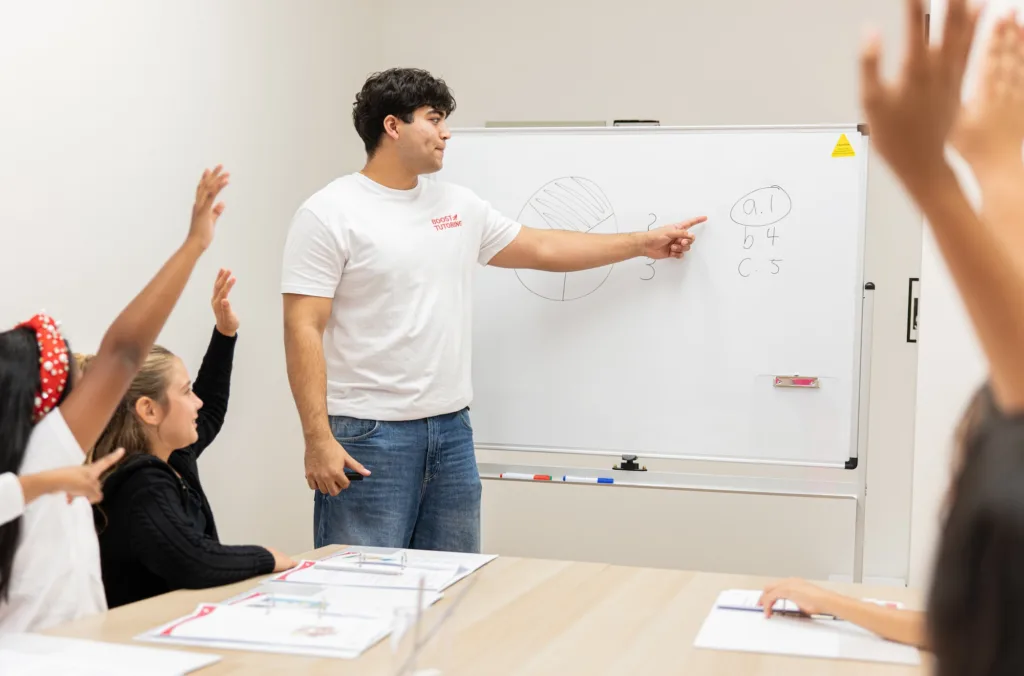
We start by finding where a child actually sits, which usually surfaces the real gap behind the current struggle rather than just the topic they’re stuck on. From there we teach for understanding, aligned to the NSW syllabus, so the maths makes sense rather than being a set of steps to memorise, and we keep it connected to what they’re doing in class. Sessions run in small groups of six to eight with the same tutor each week, built around Prime, Train, Retain, with daily practice at home to lock it in. Because it’s the same tutor each week, they get to know how a child thinks and can target the work precisely.
The aim is a student who understands high school maths well enough to keep up as it builds, rather than falling further behind each term.
High school maths is where small gaps start to compound and where a lot of children quietly decide they’re “bad at maths.” The way out is to find the real gap, rebuild the understanding underneath it, and let genuine progress do the work on confidence. The place to start is a clear picture of where your child actually sits.
Find out where your child actually sits, and where the real gap is











