
The narrative comes home marked eighteen out of twenty, and next to a strong opening paragraph, a red circle sits around “were” where it should read “was”, another around a missing full stop, a third around a comma stitched into the wrong spot. Your Year 5 child shrugs it off. “I know that one, I just forgot.”
Two stories later the red circles are back around the same three spots, and “just forgot” has stopped explaining much of anything. By then it’s a pattern, and that is what grammar tutoring exists to interrupt.
On Tuesday’s worksheet a child corrects “were” to “was” in seconds, and can even say which rule applies. By Thursday’s story the same “were” is back on the page, because a plot and a rule are both drawing on working memory at the same moment, and the plot wins more often than not. The gap is ordinary, and families usually spot it only once the marked-up page is home, long after the story was written. What does close it, then? It’s enough supervised repetition inside real writing.
Why Understanding a Rule Doesn’t Stop the Same Mistake
Recognising a correct sentence on a worksheet is one thing. Doing the same while your child juggles word choice, story order and what happens next is a different skill, even though both lean on the identical rule.
The NSW Department of Education’s own primary English professional learning treats that gap directly. Teachers using that material work on sentence-level understanding as a strand of its own, one that goes beyond the rules a student can recite alone. A quiz can come back nine out of ten while the story beside it slips from past into present tense by its third line.
The quiz only asks for recognition. The story asks for production under load, with a plot and a deadline competing for the same attention.
One tense shift or one missing apostrophe surviving a single assignment isn’t much to worry about. The same error surviving four or five assignments, despite being corrected each time, usually means something more specific. A child hasn’t yet learned to catch the mistake without an adult pointing it out first. It isn’t a sign the rule was never taught. It’s a sign the rule hasn’t been practised in the exact conditions your child’s writing actually demands, mid-sentence and mid-idea, with no red pen anywhere in sight.
The Sentence Skills That Actually Carry a Mark
A couple of habits carry most of a writing mark, and neither one needs a long list of memorised rules.
The first is a sentence that actually holds together from its first word to its last. Fragments and run-ons break it, and so does a verb that won’t agree with its subject, or a pronoun whose referent exists only in the writer’s head.
The second is staying consistent once a sentence gets going. A paragraph that settles on a tense keeps it, and an apostrophe marks ownership, as in Mia’s pencil.
That second habit leans heavily on punctuation, and punctuation is easy to underrate. Shift one comma and a sentence can end up meaning something else entirely. Clarity and precision ride on those marks, which is why the Australian Education Research Organisation’s practice guide on punctuation recommends teaching them alongside sentence structure from the outset.
The read-aloud test takes about two minutes at home. A child reads a recent story out loud, then explains why one full stop sits where it does, and a specific reason shows the rule already belongs to them. A shrug or a lucky guess means it’s still on loan.
When Home Corrections Reach Their Limit
Circling an error and writing the fix beside it is where home correction usually stops. A habit needs a four-step cycle: the error gets spotted, the child explains plainly why it’s wrong, the sentence is fixed, and a brand-new sentence written alone applies the same rule. Skip that last step and the correction stays attached to one sentence, instead of becoming a rule a child can reach for again independently.
Spelling carried the most weight in predicting NAPLAN writing quality among 819 Australian primary students, according to a study in the Australian Journal of Education. Grammar and punctuation also predicted that outcome, which is why grammar rarely works alone.
Home proofreading genuinely helps, and you shouldn’t stop doing it. It does, though, have a ceiling. If the same three or four mistakes keep turning up across different pieces of writing, if your child can’t explain a correction back once it’s been made twice, or if catching the error still depends entirely on an adult reading over their shoulder, that’s less about the child and more about what home correction alone can teach. Some families reach that point and look at English tutoring in Castle Hill instead of adding another worksheet to the kitchen table routine, simply because a tutor can supervise that fourth step far more often than a busy evening at home allows. That’s exactly where structured grammar tutoring earns its place.
How to Turn One Mistake Into a Lasting Habit
An hour of generic worksheets the night before an assessment teaches less than ten minutes, a few evenings a week, on the one error that keeps coming back. Those ten minutes work best inside a paragraph the child is already writing for school, where the fix lands on real work.
The same logic holds outside term time too. Short and consistent wins over long and occasional, whether it’s week three of the term or week two of the holidays, which is the whole idea behind school holiday English tutoring in Castle Hill.
Grammar tutoring, or any structured English tutoring program, tends to make the most sense once a family notices two or three signs together, such as the same mistake showing up across several pieces of writing, real trouble explaining a correction back, or a report comment about “careless errors” that doesn’t shift term to term despite genuine effort at home. None of that means a child is behind. It usually just means the rule needs more supervised reps than a busy household can fit in around dinner and homework.
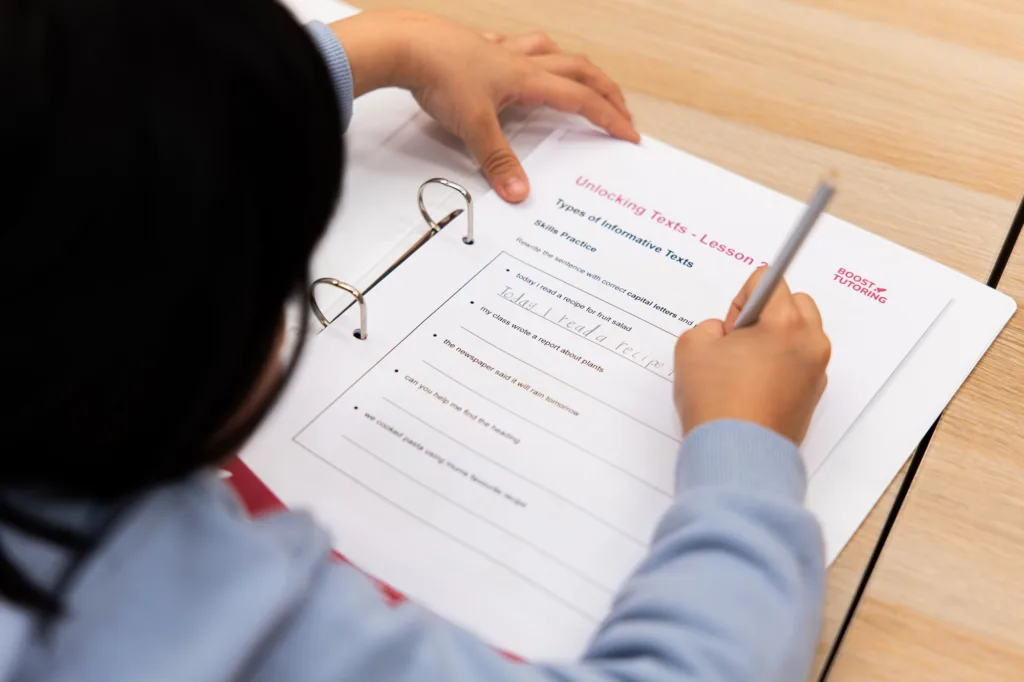
This is why every Boost session opens with five minutes of skills work, quick grammar checks, sentence patterns and vocabulary in context, before moving into the day’s English content in a small group with the same tutor each week at Boost Tutoring Castle Hill. It isn’t about racing ahead of the term’s work. It’s about making sure the grammar a child can already half-recite becomes grammar they can actually use on the page.
If the same grammar mistakes keep resurfacing assignment after assignment, an assessment with Boost Tutoring Australia will show exactly which habits need attention before your child’s next piece of writing loses marks to something a few focused weeks could fix.
Book a free academic assessment and see exactly where your child’s foundations sit.