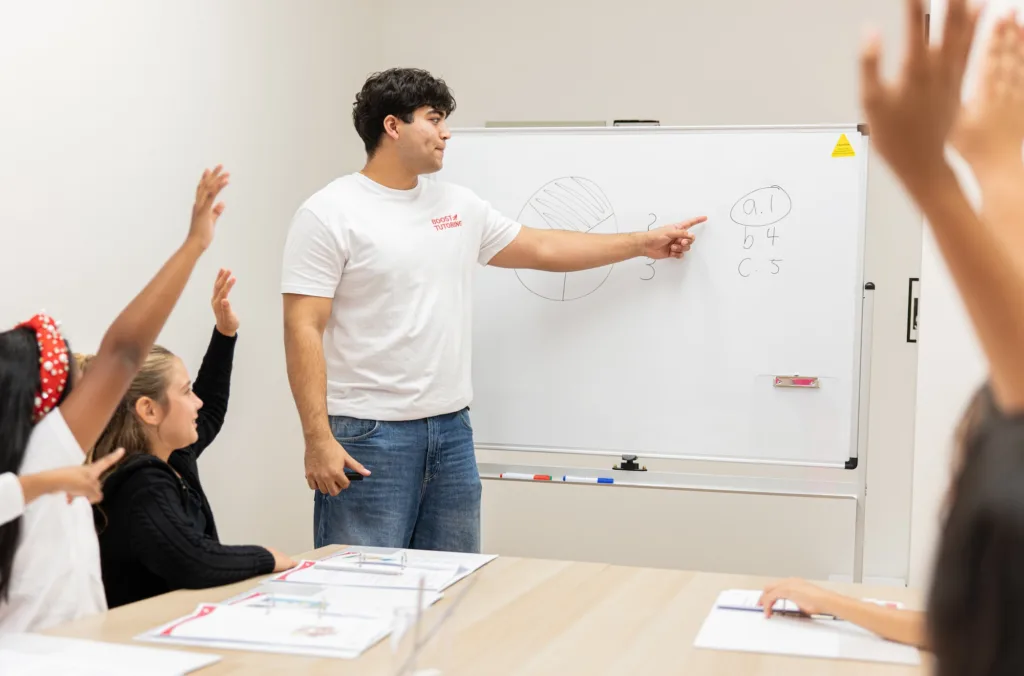
Of all the subjects, maths is the one parents are most reluctant to trust to a group. The reasoning feels sound: maths is hard, every child is at a different point, surely a child needs one-on-one attention to get it. So small-group maths tutoring can seem like a compromise, the option you settle for rather than the one you’d actually choose.
In fact, maths is one of the subjects a small group suits best, provided the group is genuinely small and genuinely taught. The very things that make maths feel like it needs one-on-one are the things a good small group handles well. Here’s why small-group maths tutoring in Beaumont Hills works, and what to look for.
Why Maths Needs a Tutor Who Can See Each Child
Two features of maths make it unlike other subjects, and both point toward a small group rather than away from it.
The first is that maths is cumulative and deeply individual. Two children in the same Year 5 class can be in completely different places, one solid on fractions, one still shaky on the times tables underneath them, one racing ahead and quietly bored. Maths, more than any subject, exposes these differences, because every child is somewhere specific on a long chain of skills. Teaching all of them the same thing at the same pace, the way a large class must, means someone is always either lost or coasting.
A small group solves this. With six to eight children, a tutor can know exactly where each one sits and pitch to it, stretching the child who’s ahead, going back for the one who’s missing a foundation. That isn’t possible in a class of thirty, and it’s the whole reason attention matters so much in maths specifically.
The second feature is the silent lost moment. In maths, when a child stops understanding, they usually go quiet, they don’t announce it. They copy down the working, nod along, and hope it makes sense later. In a big class, that silence is invisible, and the gap grows unnoticed. In a small group, a tutor can see the exact moment a child goes still and step in, which is often the difference between a small wobble and a lasting gap.
What a Good Small-Group Maths Session Does
A well-run small-group maths session does a few things a crowded room, or a bag-of-tricks tutor, can’t.
It meets each child at their actual level. The tutor isn’t running one lesson at everyone; they’re moving between children working at the point each one needs, which is how maths has to be taught given how individual it is.
It catches errors as they happen. In maths, a misunderstanding practised twenty times becomes a habit that’s hard to undo. A tutor moving around a small group spots the mistake on the second question, not after the whole page is wrong, and corrects the thinking before it sets.
It teaches understanding, not just answers. Good small-group maths makes the reasoning visible, why a method works, so children can adapt to unfamiliar questions rather than only repeating what they’ve practised. That’s as true in a group as one-on-one, and a small group has the bonus that children pick things up from seeing a classmate approach a problem a different way.
And it builds in the reps. Maths is built on practice, and a small-group session that ends with each child working through the content themselves, with the tutor nearby, is exactly the kind of practice that makes it stick.
When Small-Group Maths Works, and When One-on-One Is Better
It’s worth being honest about the exception. If your child has one specific, urgent problem, a single topic to sort out before a test in a fortnight, then focused one-on-one is faster for that narrow job. There’s no point pretending otherwise.
But for what most families actually want, steady progress in maths, strong foundations, a gap closed properly, confidence rebuilt across a year, a small group is usually the better fit. It gives real, individual attention without the intensity of being watched every second, which many maths-anxious children find far easier, and it’s affordable enough to do consistently, which is what maths progress actually requires. Maths isn’t improved in a burst. It’s improved by turning up, week after week, and a small group makes that sustainable.
How We Run Small-Group Maths in Beaumont Hills
At Boost, maths runs in small groups of six to eight with the same tutor each week, aligned to the NSW syllabus, for students from Kindergarten through to Year 10. Every child works at their own level, because that’s the only way maths can sensibly be taught.
We start by working out exactly where a child sits, which in maths usually means finding the real gap, often a year or two below where the trouble shows. Then each session follows the same shape: a few minutes of skills work to keep the times tables and number facts automatic, then real teaching with the reasoning made visible, then the child working through it themselves until it holds. Prime, Train, Retain. The same tutor each week means someone who knows exactly where your child sits on that long chain of skills, and notices the moment they go quiet. It carries on at home through a short daily worksheet, because maths is built on reps.
Small-group maths tutoring isn’t the compromise it can look like. For a subject as cumulative and individual as maths, a genuinely small, well-taught group gives a child real attention, immediate feedback and the consistency maths actually needs. The place to start is simply finding out where your child’s maths sits right now.
Find out exactly where your child’s maths sits, and where the real gap is