Year 8 is the forgotten year of high school maths. Year 7 has the drama of starting high school, new school, new teachers, the shock of harder content. Year 9 has NAPLAN and the first real talk of senior subjects. Year 8 sits quietly between them, with no milestone to mark it, and so it tends to slip by without much attention. That’s a mistake, because Year 8 is often exactly when a wobble that started in Year 7 quietly hardens into something lasting.
If you’re considering Year 8 maths tutoring in the Hills District, here’s what’s really happening this year, why it matters more than it looks, and what helps.
The Year After the Wall
For a lot of students, Year 7 maths is a shock. The jump to abstraction, the arrival of algebra, the faster pace, it catches out plenty of capable students, and it exposes any gaps left over from primary. Some students adjust. Others come out of Year 7 a little behind, a little shaken, and not quite sure what went wrong.
Year 8 is where that fork plays out. A student who addresses the Year 7 gaps gets back on track. A student who doesn’t carries them into Year 8, where the content builds on exactly the things they didn’t master, and the gap compounds. By the end of Year 8, a wobble that could have been steadied a year earlier has often become a settled belief: “I’m just not good at maths.”
That belief is the real danger, more than any single topic. A student who’s decided they can’t do maths stops trying, and stops doing the work that would prove them wrong. Year 8 is frequently where that belief sets in, which is precisely why it’s a year worth paying attention to, even when nothing dramatic is happening on the surface.
What Year 8 Maths Actually Demands
Year 8 maths assumes Year 7 was solid, and builds straight on it.
Algebra deepens. Where Year 7 introduced the idea of using letters for unknowns, Year 8 pushes into expanding brackets, factorising, and solving harder equations. A student who never quite grasped what algebra was doing in Year 7 finds Year 8 algebra genuinely hard, because it’s more of a thing they didn’t understand in the first place.
The content broadens, too, into topics like indices, Pythagoras, and more demanding work with fractions, ratios and percentages, much of it more abstract than anything in primary. And the pace doesn’t let up.
The thread running through it is that Year 8 rewards understanding and punishes gaps. A student who’s solid on the foundations, number fluency, fractions, negative numbers, what algebra actually means, can take on the new material. A student carrying gaps from Year 7, or further back, finds each new topic harder than it should be, because it’s sitting on ground that isn’t stable.
Why Year 8 Matters More Than It Looks
It’s tempting to treat Year 8 as a holding year, especially with no external exam to focus the mind. That’s the trap.
Year 8 feeds directly into Years 9 and 10, which are where it starts to count in a concrete way. Performance in those years shapes which maths course a student can take in Year 11, and by extension what’s open to them later. A student who drifts through Year 8, letting gaps compound, can find their options quietly narrowing a year or two later, not through lack of ability, but through a year of ground lost at the wrong moment.
So Year 8 is a quiet year with real consequences. The absence of a big exam makes it easy to ignore, and the compounding nature of maths makes ignoring it costly. It’s one of the best times to steady a student who wobbled in Year 7, precisely because there’s room to do it calmly before the stakes rise.
How We Approach Year 8 Maths in the Hills District
Boost Secondary covers Years 7 to 10, and Year 8 is one of the most useful points to step in, because there’s still time to address a Year 7 wobble before it compounds.
We start by working out where a student actually sits, which for a Year 8 student finding algebra hard very often means finding a gap further back, in Year 7 algebra, or in fractions or negative numbers from primary. There’s no sense drilling Year 8 algebra on top of a foundation that isn’t there.
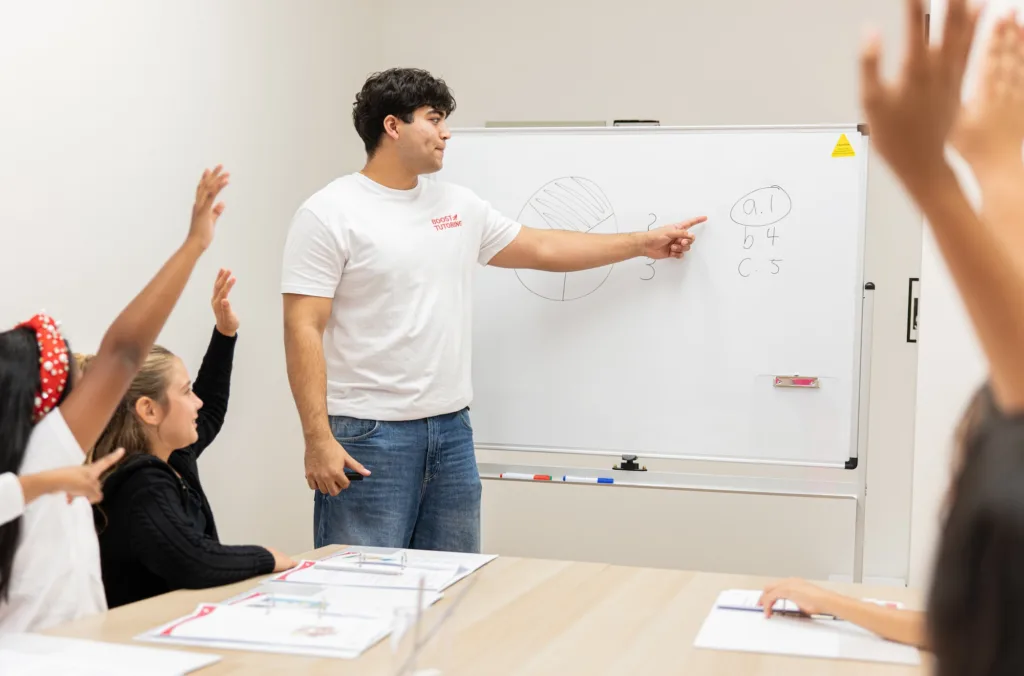
From there, maths runs in small groups of six to eight with the same tutor each week, aligned to the NSW syllabus. Each session opens with a few minutes of skills work to keep the number fluency sharp, then real teaching with the reasoning made visible, so a student understands what they’re doing rather than memorising steps, then the student working through it themselves until it holds. Prime, Train, Retain. It carries on at home through a short daily worksheet, because fluency is built on reps.
The aim is a student who finishes Year 8 solid and steady, with any Year 7 gaps closed, ready for the years where it starts to count.
Year 8 is quiet, which is exactly why it’s easy to let slide, and exactly why it matters. It’s the year a Year 7 wobble either gets steadied or hardens, and the gaps it leaves feed straight into the years that shape a student’s options. The place to start is finding out where your child’s maths actually sits.
Find out exactly where your child’s maths sits, and whether a Year 7 gap is still there