Every school report splits English into reading and writing, and most parents read the two marks as a single verdict on whether their child is “good at English.” But reading and writing are genuinely different skills, and plenty of children are strong in one and shaky in the other.
What’s less obvious, and more useful to understand, is that the two are far more connected than they look, and the best way to build either is often to build both. Here’s how reading and writing actually work, and what that means for English tutoring in Castle Hill.
The Reading Half
Reading sounds simple, and the simple part, turning the words on a page into speech, is only the beginning. The reading that actually matters is comprehension: understanding what’s been read, following an idea, and picking up on what a text implies but doesn’t say outright.
This is where a lot of children quietly fall short, and it’s easy to miss, because a child can read aloud beautifully and still not have understood much. Fluent reading hides weak comprehension. A child who reads a passage smoothly and then can’t tell you what it was about has a gap that nobody notices until the questions get harder.
Good reading also means reading widely. A child who reads across many kinds of books builds vocabulary, absorbs how language works, and brings more understanding to whatever they read next. This matters in every subject, not just English, because comprehension underpins maths word problems, science questions, almost everything. Reading is the skill the whole of school sits on.
The Writing Half
Writing is the other half, and it’s the one children most often find hard, because it asks them to produce rather than absorb.
The biggest misconception about writing is that it’s a talent you either have or you don’t. It isn’t. Writing is a craft with learnable parts: planning what you’re going to say, structuring it with a clear beginning, middle and end, building a paragraph around a point, choosing words with some care. A child who’s been taught these things writes far better than one left to work it out alone, regardless of natural flair.
The most common place children lose marks is structure. A piece with good ideas but no shape reads worse than a plainer piece that’s well organised, because a reader can only follow what’s been laid out clearly. Teaching a child to plan before they write, and to give a piece a deliberate structure, is the single highest-value thing you can do for their writing, and it improves their work quickly.
How Reading and Writing Feed Each Other
Here’s the part most approaches miss, and it’s the reason to build both together rather than treating them as separate subjects.
Reading is where a child gets the raw material for writing. Every book a child reads is a quiet lesson in how sentences are built, how stories are shaped, how arguments are made, how good writers use words. A child who reads widely absorbs all of this without trying, and it shows up in their own writing. This is why strong readers so often become strong writers, and why a child who reads little tends to find writing much harder, they’re trying to produce something they’ve rarely seen modelled.
It runs the other way too. Learning to write, to structure an argument, to notice how a paragraph is built, makes a child a sharper reader, because they start to see what writers are doing and why. The two skills lift each other.
The practical upshot is simple. If a child’s writing is weak, part of the answer is often more and better reading. And the best English teaching works on both at once, using each to strengthen the other, rather than drilling them in isolation.
How We Approach English Tutoring in Castle Hill
At Boost, English is built around exactly this: reading and writing together, each reinforcing the other.
We work on comprehension beyond fluency, teaching children to understand deeply and read between the lines, and we build vocabulary deliberately, because it feeds both halves. On the writing side, we teach the craft, planning, structure, building a clear piece, so a child learns that good writing is made rather than simply born. And we use the reading to feed the writing, and the writing to deepen the reading, instead of treating them as two separate exercises.
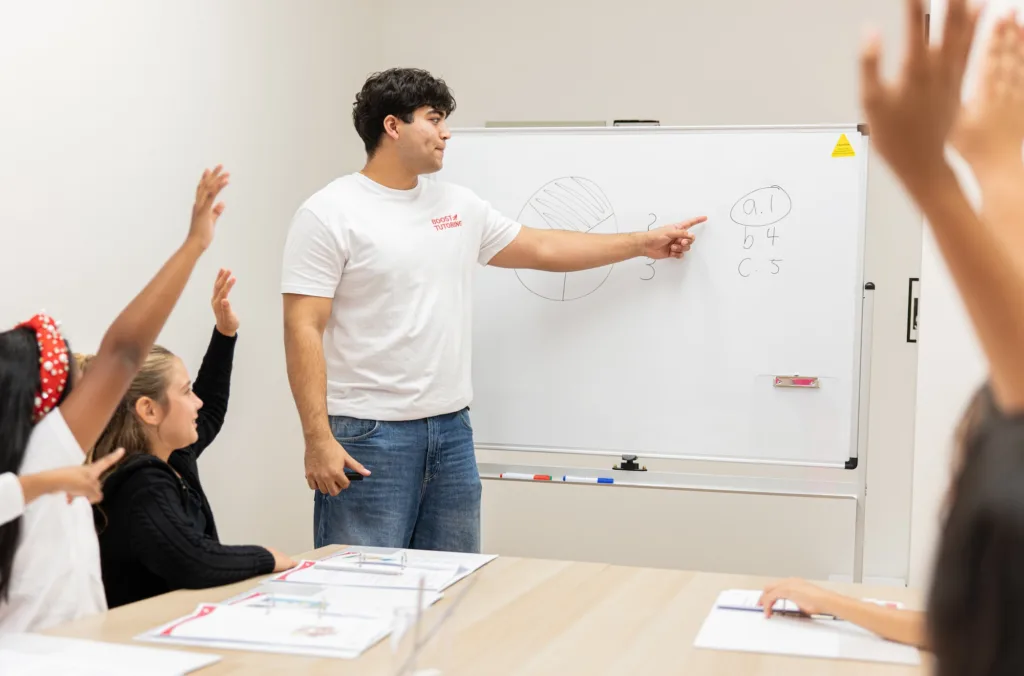
Sessions run in small groups of six to eight with the same tutor each week, aligned to the NSW syllabus, built around Prime, Train, Retain: a few minutes of skills work, often vocabulary or comprehension, then real teaching, then the student working through it themselves until it holds. It carries on at home through a short daily worksheet, because reading and writing both improve with regular practice rather than occasional bursts.
Reading and writing are two halves of the same skill, and they grow fastest when they grow together. A child who reads deeply and writes clearly has something that serves them in every subject and well beyond school. The place to start is knowing exactly where your child’s reading and writing actually sit.
Book a free academic assessment and see where your child’s reading and writing stand