
It’s 5:40pm. The kitchen bench is half kitchen, half homework: a maths worksheet wedged under the fruit bowl, a phone lighting up with notifications three centimetres from your daughter’s elbow, and dinner that needs to go on in ten minutes. Twenty minutes in, she’s written two sentences and asked to go to the toilet twice. It’s not that she doesn’t understand the maths. It’s that this stretch of kitchen bench was never really set up to be a study space in the first place.
Most parents assume this is a willpower problem, or a motivation problem, or maybe this particular subject just doesn’t suit this particular kid. Often it’s simpler than that. It’s the space. Where your child sits down to do schoolwork is doing more work than most families give it credit for, and it’s one of the few parts of the whole homework battle you can actually control tonight, not eventually.
A study space doesn’t need to be a dedicated room, a new desk, or anything you have to buy. It needs to do a few specific jobs well. Here’s what that actually looks like.
Why the Same Spot Matters More Than the Best Spot
Parents often spend real energy hunting for the perfect study space: good light, a door that closes, distance from siblings. All useful, none of it matters as much as one thing: using the same spot every time. A brain that walks into a familiar setting where homework has happened forty times before doesn’t need to decide anything.
It just starts. A brain that’s working from the couch on Monday, the kitchen table on Tuesday and a bedroom floor on Wednesday spends the first five minutes of every session working out how to work, before it’s touched a single question. The kitchen table is a perfectly good study space if it’s the same table every school night. A rotating set of “wherever’s free” is not, no matter how comfortable any one of those spots might be.
Clear the Bench Before the Books Come Out
Visual clutter is a genuine cost to a developing brain, not just an aesthetic complaint. A desk covered in yesterday’s mail, a charging cable, three unrelated toys and a half-finished snack gives a child dozens of small, competing things to look at before they’ve even opened their book. Clear the surface down to what’s needed for tonight’s work and nothing else.
The phone goes in another room, not face-down on the table; face-down still buzzes, and a buzzing phone three centimetres away is still a phone three centimetres away. If a screen is required for the task, close every tab and app that isn’t it before starting, not after the first distraction has already happened.
Put the Supplies Where the Work Happens
Every trip to find a ruler, a calculator or a fresh page is a full stop in concentration, and concentration doesn’t restart from where it left off. It restarts from scratch. Keep a small, boring kit at the study space itself: pens, pencils, an eraser, a ruler, spare paper, a calculator if it’s needed for the year level. It costs a few minutes once to set up and saves that same few minutes, many times over, every single night. If a particular subject needs something specific, like a maths workbook or a set of vocabulary cards, that goes in the kit too, not in a drawer three rooms away.
Get the Light and the Chair Right
A child working on the floor, slouched on a couch or squinting under a single dim ceiling light is fighting their own posture and eyesight on top of the actual schoolwork. Neither one needs anything expensive to put right. A proper chair at a proper height, feet flat on the floor, and a light source that’s actually pointed at the page rather than somewhere behind the child’s head make a genuine difference to how long they can concentrate before they start fidgeting. This is especially true for younger primary students, who are still building the basic stamina to sit and focus for any stretch of time at all.
Give the Study Space a Job to Do
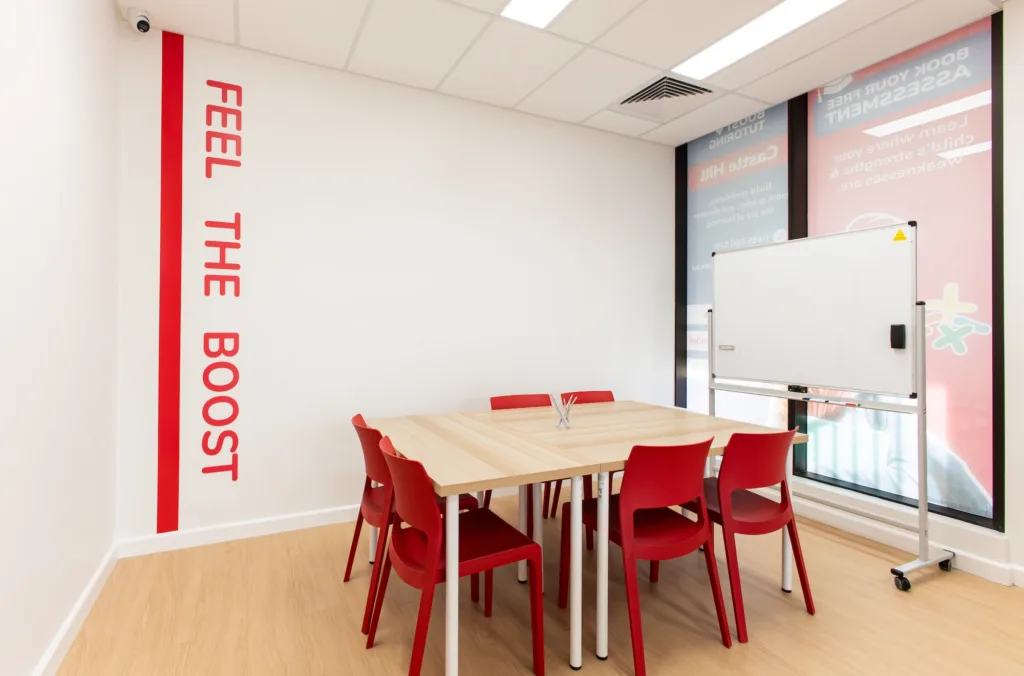
The most useful study spaces develop a small, consistent ritual that signals the brain to switch modes: clearing the table, putting the kit out, sitting down at the same chair. Over a few weeks, that short sequence starts doing real work on its own, the same way pulling into a driveway signals “home” before you’ve even opened the car door. This is exactly the thinking behind how we run every Boost session. Students walk into the same room, sit in the same small group, and start with the same five minutes of skills work before the main teaching begins. Nobody has to be talked into starting, because the space and the routine have already done that job before the first real question is asked.
What This Looks Like in the First Week
Don’t expect a new study space to turn a shaky homework habit around overnight. The first few sessions in a new spot will still involve some resistance, because habits take longer to build than furniture takes to move. What you’re watching for isn’t instant enthusiasm, it’s a slow drop in the friction before your child actually sits down: fewer trips to find a pencil, fewer “just five more minutes” delays, a little less negotiation each week. That quiet improvement is the real sign the space is doing its job, well before report cards or test results show anything.
A good study space won’t turn a reluctant learner into an enthusiastic one by itself, and it isn’t a substitute for a child actually understanding the work in front of them. But it removes a whole category of unnecessary friction, and for a lot of families, that friction is a bigger part of the nightly battle than the schoolwork itself. If your child is doing everything right in a space that’s working against them, that’s worth sorting out before anything else.
Book a free academic assessment and see exactly where your child’s foundations sit











