
“I hate maths.”
It lands somewhere between an announcement and a wall. And most parents respond in one of two ways: pushing back “you don’t hate maths, you just need to practise,” or quietly conceding “that’s alright, I was never a maths person either”. Both are understandable. Both make it worse.
Here’s the thing worth knowing. Children almost never hate maths for its own sake. “I hate maths” is nearly always a translation of something else, and if you can work out what it’s actually saying, you can usually do something about it.
What “I Hate Maths” Usually Means
Most of the time, it means “maths makes me feel stupid.”
That’s the real content. Somewhere along the way, maths stopped making sense, and the experience of sitting in a class where everyone else seems to follow and you don’t is genuinely horrible. Hating the subject is a rational response to a subject that reliably makes you feel bad about yourself. Any of us would do the same.
Sometimes it means “I’ve decided I can’t do this.” A child who has concluded they’re not a maths person has made a decision that protects them. If you’re not a maths person, then not understanding maths isn’t a failure. It’s just who you are. It’s a self-protective belief, and it’s remarkably durable once it forms.
Sometimes it means “it’s boring,” which usually means it’s either too hard to engage with or too easy to bother with.
And occasionally it means “it’s hard, and I’m allowed to say so,” which is fine and doesn’t require intervention.
The common thread in the ones that matter is that the feeling came first and the hatred followed. Nobody hates something they’re good at.
Why It Matters More Than It Seems
The reason not to shrug this off is that the belief does the damage, not the gap.
A child who has decided they can’t do maths stops trying. They don’t attempt the hard question, because why would you attempt something you know you’ll fail? They disengage in class. They avoid the practice that would actually help. And so the gap grows, which confirms the belief, which causes further disengagement.
That’s the spiral, and it’s the whole problem. The maths gap is fixable at almost any stage. The belief is much harder to shift once it’s set, because it stops the child doing the very things that would disprove it.
Which is why “that’s alright, I was never good at maths either” is such a costly thing to say, however kindly it’s meant. It hands the child permission to stop trying, and it tells them the belief is true.
What Actually Turns It Around
Three things, in this order.
Find the gap. Not the current topic, the actual gap, which is usually further back. A child who hates maths is nearly always a child who stopped understanding it at a specific point, and everything after that point has been noise. Find that point and you’ve found the problem. This is often a genuine relief for the child, because it reframes them from “bad at maths” to “missed a step,” which is a completely different story about themselves.
Rebuild some success. Confidence doesn’t come from encouragement, it comes from evidence. A child needs to actually do some maths successfully, at a level they can handle, to start believing they can. That means going back to work they can do, which feels like a step backwards and isn’t. It’s laying a floor to stand on.
Then move forward slowly enough that success continues. The moment you push a fragile child back into work they can’t do, the belief reasserts itself. Progress needs to be paced so that the child keeps experiencing “I can do this,” because that’s the only thing that erodes “I can’t.”
Meanwhile, watch your own language. Don’t confirm the belief. Don’t say you were bad at maths either. Don’t treat maths ability as a fixed trait a person either has or doesn’t. Treat it as something built, because it is.
How We Approach This at Boost
A child who has decided they hate maths is one of the most common students we see, and the approach is always the same.
We start by finding where the ground actually gets soft, which is usually further back than anyone expects. Then we build from there, at a level where the child can experience some success, which is the only thing that shifts the belief.
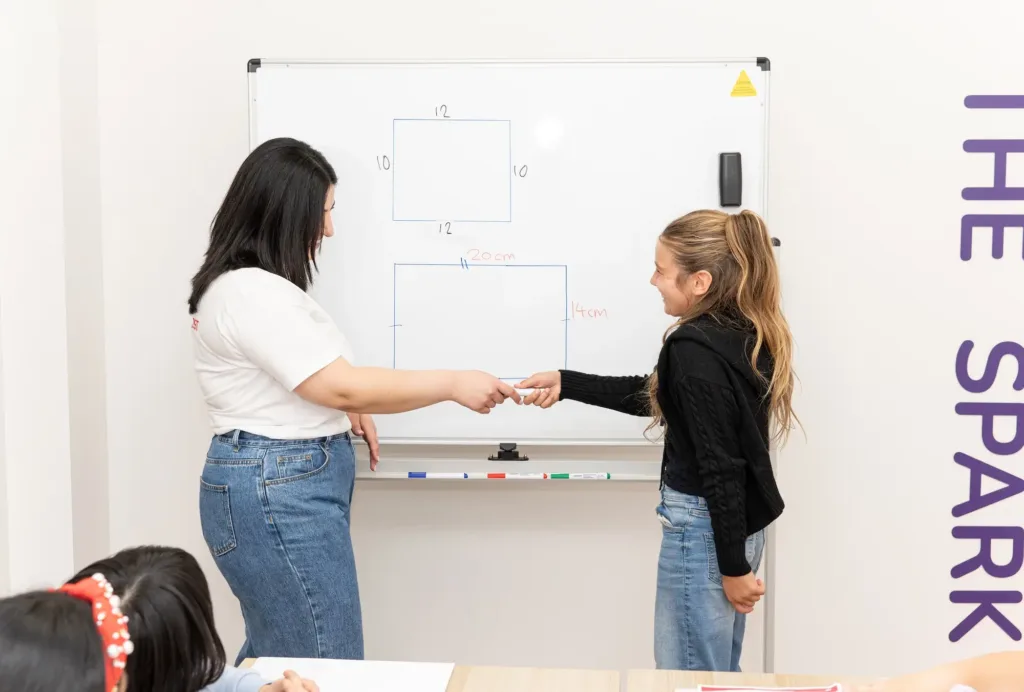
Sessions run in small groups of six to eight with the same tutor each week, which matters here in a way it might not for a confident child. A small group is safe enough to admit you don’t understand, which a class of thirty rarely is. And the same tutor each week means someone who knows this particular child’s history, and who notices the moment they go quiet.
Each session opens with a few minutes of skills work, then real teaching, then the student working through it themselves until it holds. Prime, Train, Retain. Getting the fundamentals automatic is a large part of the confidence battle, because a child who isn’t fumbling the basics has room to think about the actual problem.
“I hate maths” is rarely about maths. It’s a child telling you something has stopped making sense and they’ve started to draw conclusions about themselves. Find the point where it stopped making sense, and you can usually change the conclusion.
Book a free academic assessment and see exactly where your child’s foundations sit