Your child finishes a maths worksheet in about four minutes flat, hands it over with a string of correct answers, and no working anywhere on the page. Showing your working feels, to most kids, like an optional extra tacked on for teachers who like neat handwriting.
When you ask where it is, you get the same answer every time: “I just knew it.” Then a test comes back with marks lost on questions where the final answer is wrong, and there is nothing on the page to show what actually went wrong. No steps, no clue, just a cross next to an answer that came from nowhere you can see.
Most parents have had some version of this argument, and most kids have a genuinely good reason for avoiding it: writing out steps feels slow, feels unnecessary when they already know the answer, and feels like busywork for a question that took two seconds in their head. The trouble is that showing your working is not really about slowing your child down. It is about two other things entirely, and once you see what they actually are, the argument at the kitchen table gets a lot easier to win.
Why Showing Your Working Earns Marks the Answer Alone Cannot
In NAPLAN numeracy, Selective maths reasoning, and any multi-step maths question from upper primary onward, marks are usually attached to the method, not only the final number. A question worth three marks might allocate one for setting the problem up correctly, one for a correct middle step, and one for the final answer.
A student who writes nothing and gets the final answer wrong walks away with zero, even if their thinking was almost entirely right. A student who shows the same almost-right thinking on paper can pick up two marks out of three for exactly the same level of understanding.
The reverse matters just as much. A correct final answer reached through a lucky guess, a memorised shortcut, or a mental leap your child cannot actually explain will eventually meet a question hard enough that guessing does not work anymore. By then, if writing steps down has never been practised, there is no fallback method to fall back on.
This is exactly why a child who seems comfortable with maths at home can still come away from a Selective or NAPLAN paper with a lower mark than expected: the questions ask for more than a correct number, and a page with nothing written on it cannot earn credit for thinking the marker never gets to see.
Working Out Is How You Find Where a Mistake Actually Started
When an answer is wrong and there is no working on the page, all you know is that it is wrong. You have no idea whether your child misread the question, made a careless slip in the middle, or genuinely does not understand the concept, and each of those needs a completely different response. A careless slip needs nothing more than a reminder to check. A genuine gap in understanding needs actual reteaching.
Written working turns a mystery into a diagnosis. A tutor, a teacher, or a parent helping with homework can look at the actual steps and point to the exact line where things went sideways, rather than guessing at what might have happened somewhere inside your child’s head. This is one of the most useful things a page of working does, and it is completely invisible when the only thing on the page is a final number.
It Builds the Habit Bigger Problems Will Eventually Demand
Working things out mentally holds up fine for a two-digit sum or a straightforward fraction. It falls apart the moment a problem has three or four steps, involves algebra, or asks your child to hold several pieces of information in mind at once, which is exactly the kind of question that starts turning up regularly from upper primary through high school. At that point, writing steps down stops being optional and becomes the only realistic way to get a reliable answer at all.
The habit needs to already be there by the time the harder questions arrive. A child who has spent years being allowed to skip working on the easy stuff because they could manage it in their head has no practised habit to fall back on when the questions get genuinely difficult, and building that habit under exam pressure is a much harder job than building it early, on easy questions, when there is nothing at stake.
Waiting until Year 8 algebra or a Selective maths reasoning paper to introduce the idea means teaching a brand-new skill and a high-stakes subject at the same time, which is a much harder combination than it needs to be.
Getting a Resistant Child to Actually Show Their Working
Telling a child to “show your working” as a general instruction rarely changes anything, mostly because it sounds like extra effort for no visible reward. A few things genuinely help. Ask for the key steps rather than a full written explanation, since three or four numbers on a page take seconds and still show the method.
Do not accept “I did it in my head” as a final answer, even when the answer given is correct, and treat it the same way you would treat a missing step in the middle of a recipe. Model it yourself occasionally when you are helping with homework, writing out your own thinking rather than just supplying the answer. And praise the process rather than only the outcome, since a child who hears “good working” as often as “good answer” learns that both actually count.
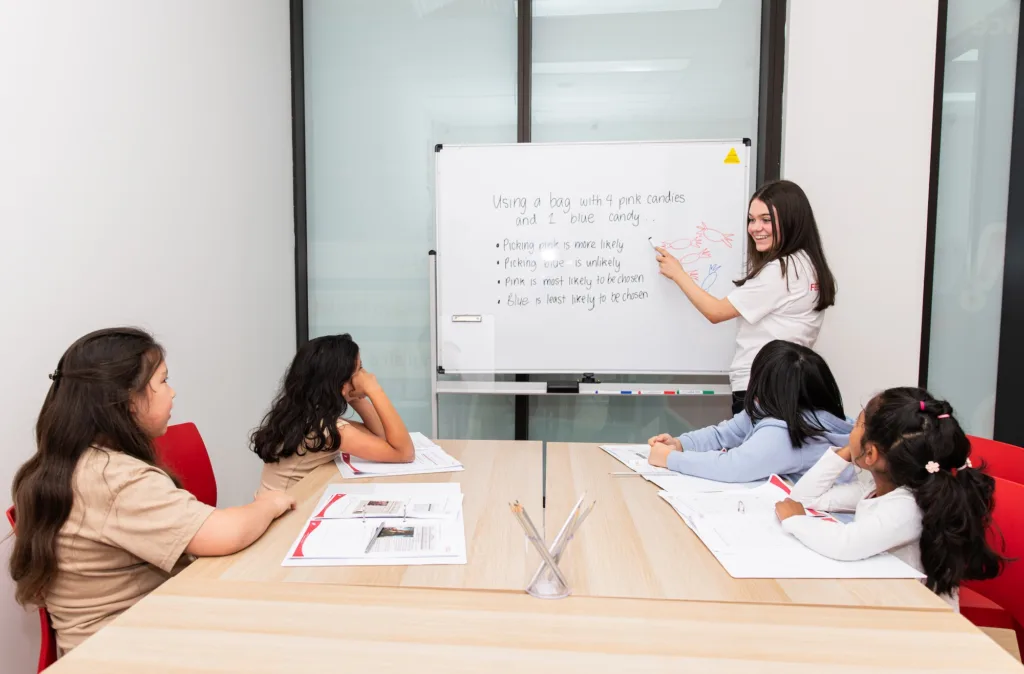
This is also where a small group setting genuinely helps. It is much harder to quietly skip a step when a tutor is looking at the actual working, not just the final answer, every single week. At Boost, the Train part of every session includes checking a student’s working line by line, and the Retain part asks them to explain how they got there, out loud, in their own words. Showing working stops being a special instruction reserved for test day and becomes simply how maths gets done, every session, without anyone needing to nag about it at home.
Book a free academic assessment and see exactly where your child’s foundations sit