Year 5 is the year maths gets real. The friendly, concrete sums of the early primary years give way to fractions, decimals and percentages, to larger calculations and to worded problems that take two or three steps to crack. For a lot of children, it’s the first year maths really asks them to think, and it’s often where the comfortable ones start to wobble and the quietly behind ones get found out.
It’s also the last clear run-up before high school, where maths speeds up and steps up again. That combination makes Year 5 a genuinely pivotal year, and it makes the specific skills built this year matter more than in almost any other. If you’re considering Year 5 maths tutoring in Castle Hill, here’s why the year matters so much, the key skills it’s built on, and what good support looks like.
Why Year 5 Is a Pivotal Year for Maths
Two things converge in Year 5, and together they matter more than either does on its own.
The first is the content itself. Year 5 is where maths shifts from mostly concrete to increasingly abstract. Children move from whole numbers they can picture to fractions, decimals and percentages, which are harder to hold in your head and which lean heavily on understanding rather than memory. These aren’t just another set of topics. They’re the gateway concepts that high school maths, and eventually algebra, are built directly on top of.
The second is timing. Year 5 sits right before the jump to high school, where the pace quickens, the content deepens, and the safety net of a single, familiar primary teacher disappears. A child who arrives in Year 7 with the Year 5 and 6 fundamentals solid has room to cope with that step up. A child who arrives with gaps spends high school trying to learn new, harder material while quietly patching old holes at the same time, which is a hard way to go about it.
Put simply, Year 5 is the last easy chance to get the foundations right before the stakes rise. Which is exactly why the specific skills a child builds this year are worth knowing, and worth getting solid.
The Key Skills Year 5 Maths Depends On
A handful of skills carry most of the weight in Year 5, and each is a common place for a child to come unstuck. These are the ones worth watching, and the ones good tutoring targets directly.
Automatic times tables and number facts come first, because almost everything sits on them. By Year 5, these need to be instant, not calculated. A child still working out seven eights is spending mental effort on the basics while the class has moved on to the actual problem, and that drain shows up everywhere, in division, in fractions, in multi-step work. Fluency here is the single most important foundation, because it frees a child’s mind to think about the harder thing on top. If only one skill is solid, make it this one.
Multiplication and division with larger numbers is the next. Year 5 moves well beyond single-digit work into longer multiplication and division, and a child who’s shaky here finds later topics, from ratios to algebra, harder than they need to be, because these operations turn up inside almost everything that follows. Where children come unstuck is usually the method breaking down under larger numbers, which nearly always traces back to the number facts underneath not being automatic.
Fractions, decimals and percentages are the big three of Year 5, and they’re really three views of the same idea. A child who understands how they connect, that a half, nought point five and fifty per cent are the same thing in three costumes, has a real advantage. A child who’s instead memorised separate rules for each comes unstuck the moment a problem looks slightly unfamiliar. This is the single most common place Year 5 maths goes quietly wrong, and it’s the one worth making sure your child genuinely understands rather than merely performs.
Place value with decimals matters more than it looks. Year 5 extends place value into decimals, and a shaky grasp of it causes errors that look careless but aren’t, lining up the wrong digits, misreading the size of a number, slipping a decimal point. Understanding what each place actually means is what prevents these, and it underpins all the decimal and percentage work around it.
Multi-step word problems round out the list. Year 5 problems increasingly ask a child to read carefully, work out what’s actually being asked, and string two or three steps together. A child can be perfectly capable at the calculations and still lose marks because they misread the question or didn’t know where to begin. This is as much a reading-and-reasoning skill as a maths one, which is why strengthening a child’s reading often lifts their maths at this age.
The thread running through all of these is that they build on each other, and on the years before. The cumulative nature of maths means a gap in one of these skills doesn’t stay put; it quietly undermines everything that comes after. A shaky grasp of fractions in Year 5 becomes a genuine problem with ratios, rates and algebra later. Catching a weak skill now is far easier than catching it then.
Whether You’re Aiming at Selective or Just Staying Solid
Families come to Year 5 maths help for two quite different reasons, and both are valid.
Some are on the Selective path. For them, Year 5 is the year preparation steps up, and strong mathematical reasoning makes up a quarter of the placement test. For these families, the goal is depth and confidence with exactly the kind of unfamiliar, multi-step problems the test tends to favour, built on top of the key skills above.
Others aren’t aiming at any exam at all. They simply want their child walking into high school genuinely on top of maths, rather than hanging on by their fingertips. That’s an equally worthwhile goal, and arguably the more common one. You don’t need a Selective ambition to make Year 5 the year you firm things up.
The good news is that the work overlaps almost entirely. Strong Year 5 foundations serve both goals, because the deep, confident understanding that helps a child in the Selective test is the same understanding that carries them through high school. Whichever camp you’re in, the job is the same: get the key skills genuinely solid, with real understanding, and build a child who’s confident rather than merely coping.
How We Approach Year 5 Maths Tutoring in Castle Hill
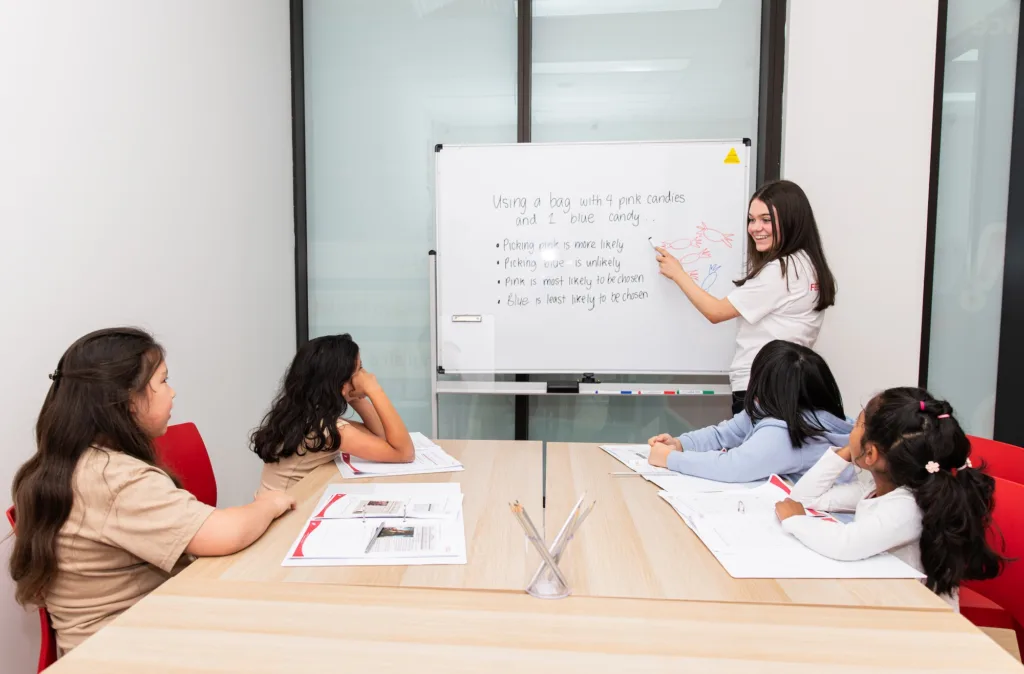
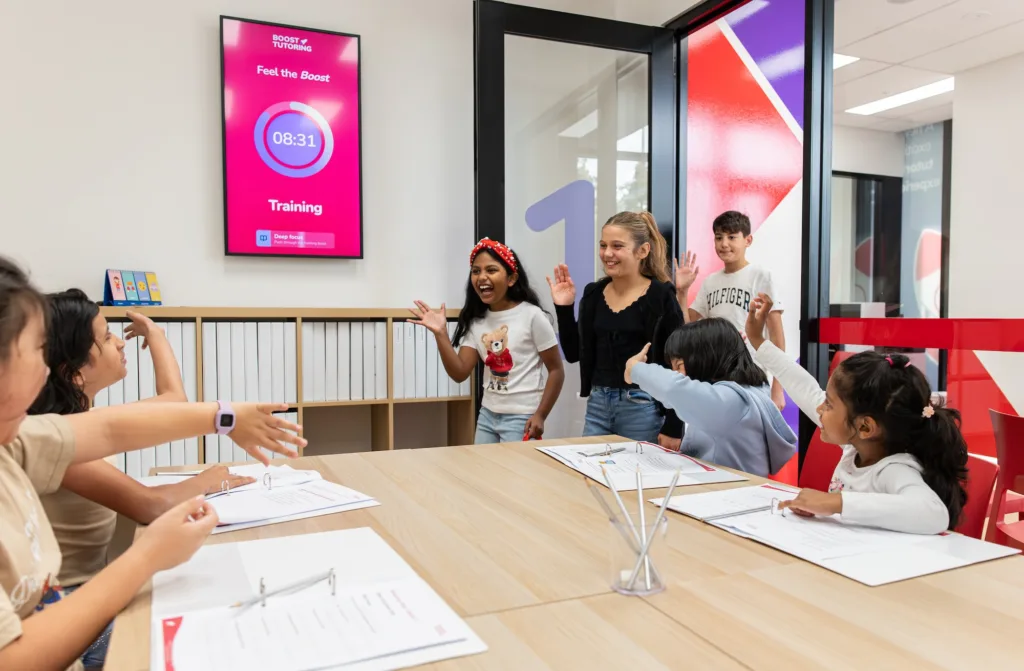
At Boost, Year 5 maths runs in small groups of six to eight with the same tutor each week, aligned to the NSW syllabus. We start by working out exactly where your child sits, because a Year 5 wall often traces back to a gap from Year 3 or 4, and there’s no sense teaching this year’s fractions on top of last year’s missing piece.
From there, each session follows the same shape: a few minutes of skills work to keep the times tables and number facts sharp, then real teaching of the current content with worked examples and the reasoning made visible, then the student working through it themselves until it genuinely holds. Prime, Train, Retain. It carries on at home through a short daily worksheet, because the fluency Year 5 demands is built through regular reps, not occasional effort.
The aim is a child who finishes Year 5 genuinely solid, with the key skills, the fractions, decimals, percentages, number fluency and reasoning, that high school and any exam will lean on. Get those right, and the years ahead become a great deal easier.
Year 5 is the window. The skills a child locks in now are the ones high school maths is built on, and it’s far easier to firm them up here than to rebuild them later.
Find out exactly where your child’s maths sits before high school, and start from there