Your child used to bring home stories they’d written just because they wanted to. Now they brings home an assessment rubric with phrases like “thesis statement” and “textual evidence” on it, and a mark that doesn’t match the confident reader you know they are. If this is their first term of Year 7 English in Beaumont Hills, you’re not imagining the gap. English changes more sharply at the start of high school than almost any other subject, and most parents only discover how much once the first real assessment lands.
It helps to know what actually shifted, because very little of it is about your child suddenly getting worse at English. Almost all of it is the goalposts moving.
What Primary School English Was Actually Testing
In primary school, English marking rewards accuracy. Can your child spell correctly, punctuate a sentence, structure a paragraph, retell a story with the right details in the right order? Most kids who read reasonably and write neatly do well by these measures, and parents get used to seeing solid results without much visible strain.
Year 7 English tests something different: argument. A high school English teacher doesn’t just want to know that your child read the text. They want to know what your child thinks the text is doing, and whether they can back that up with evidence. That’s a genuinely new skill, not a harder version of the old one, which is why a child who coasted through Year 6 can suddenly look like they’ve fallen behind in Term 1 of Year 7.
The Three Things That Actually Change
The first change is the writing itself. Primary school writing is mostly narrative and recount, built around what happened and in what order. High school introduces the text response essay, where your child has to form a view about a novel, poem or film and defend it using quotes as evidence. This usually follows a paragraph structure like PEEL, topic sentence, evidence, explanation, link, which sounds simple until you realise it asks a twelve-year-old to build and support an argument, something they’ve likely never formally been taught to do.
The second change is vocabulary, and not the kind on a spelling list. Year 7 English comes with its own technical language: techniques, motif, characterisation, tone, connotation. Your child isn’t just learning to read texts more closely; they’re learning a whole new set of words for talking about how texts work. Half the early difficulty in Year 7 English is really a vocabulary problem wearing a comprehension disguise.
The third change is independence. In primary school, one teacher who knew your child well guided them through most of the year. In high school, your child studies English with a teacher who’s meeting thirty new faces across several classes, homework is set with less scaffolding, and there’s a real expectation that your child manages their own notes, drafts and deadlines. For a lot of Beaumont Hills families, this is the first year homework genuinely can’t be supervised sentence by sentence, because the parent doesn’t necessarily know the text either.
Why the First Assessment Often Comes as a Shock
Put those three changes together and you get the pattern schools see every February and March: a child who was a strong, confident English student in Year 6 gets their first Year 7 essay back with a mark well below what the family expected, and nobody involved thinks the child got less capable over the summer. What happened is that the task changed shape faster than the skill had time to catch up.
This matters because the instinct many parents have is to worry that something’s gone wrong, when the more accurate read is that a new skill needs building, the same way a child learning long division needs new steps taught, not just more effort at the old ones. It also explains why a strong reader can still lose marks: reading the novel was never the hard part. Building an argument about it, in formal written English, under a time limit, is the actual test, and that’s a skill schools spend all of Year 7 developing, not one students are expected to arrive with.
Local high schools around Beaumont Hills vary in how much scaffolding they give for that first essay, some hand out a full paragraph template, others expect students to work it out from worked examples, but the underlying skill being assessed is the same everywhere. Knowing that in advance is more useful than knowing which particular school does which.
How to Help Without Taking Over the Essay
The most useful thing a parent can do isn’t proofreading or rewriting sentences. It’s helping your child talk through their argument before they write it. Ask what they actually think the author is doing, and why. If they can say it out loud in a full sentence, they can usually get closer to writing it down. Reading the marking rubric together also does more than most people expect, because it turns a vague mark into a specific, learnable target: which line on that rubric did the essay miss, and what would move it up one band.
It’s also worth resisting the urge to close the vocabulary gap by handing over a list of literary terms to memorise. Terms stick when they’re used in context, working through a paragraph and asking “what technique is this line actually using, and what’s the effect,” rather than studied like a spelling test. A simple version of this works well at the kitchen table: pick one paragraph from whatever your child is studying, ask them to find one piece of evidence for their argument, and ask them to explain in their own words why the author chose it. That one habit, repeated a few times a week, does more for essay marks than an hour of proofreading ever will.
Where Boost Fits In
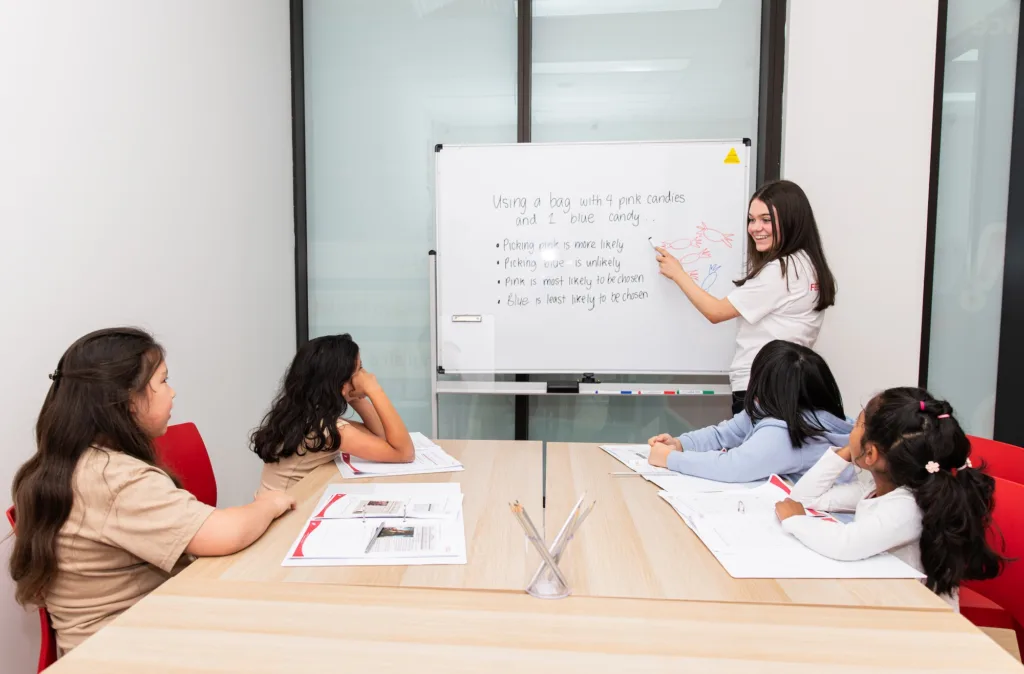
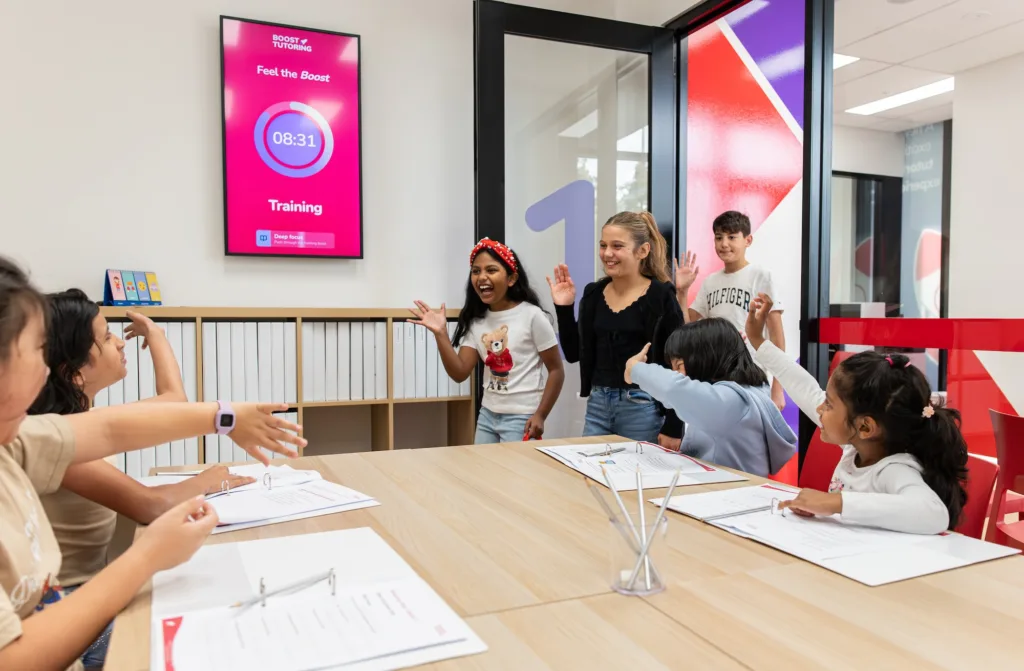
This is exactly the kind of shift our Year 7 English sessions are built around. Every class opens with five minutes of skills work on the terminology and comprehension habits that trip students up in Term 1, before moving into guided practice on the actual essay structure high school now expects. It’s not about redoing primary school English better. It’s about deliberately building the new skill, in a small group where a tutor can see exactly where the gap is, rather than hoping it closes on its own by Year 8.
If your child’s first Year 7 English results didn’t match what you expected, that’s common, and it comes right with the right kind of practice rather than more pressure at home.
Book a free academic assessment and see exactly where your child’s foundations sit