Tuesday’s maths homework comes home as one double-sided sheet. At the kitchen bench, a Year 4 child clears the twenty subtraction sums on the front well before the pasta water boils. Then they flip the page to the maths word problems. The pencil stops. Five minutes later there’s one answer on the page. It’s wrong, and the question drifting across the bench is “Do I add or take away?” It’s the same child, and mostly the same numbers, and the only real change is that nobody told them which sum to do.
A lot of Hills District parents are caught off guard here, since the front looked so secure. Stacking up more worksheets rarely fixes it, because the snag is in the reading. Sorting out what matters and talking through how the numbers fit is the real work, and it can begin at home.
Why Maths Word Problems Are Harder Than They Look
With a word problem, a child’s pencil usually hovers for a while before any sum gets written. That pause is the child picturing the story and deciding which sum actually answers the question. When children stall, the arithmetic is rarely what trips them. They’re stuck on that step before it.
Understanding the Question Before Calculating
Most children grab the two numbers in a story within seconds of reading it. Ask what one of those numbers counts and the reply is often a shrug, which tells a tutor plenty. To be fair, the answer can still come out right, since a shop with 74 apples and 22 fewer peaches than apples gives 52 to anyone who subtracts.
A slower reader, asked why it’s 52, says something like “there are fewer peaches, so that pile’s smaller.” It’s the same sum on paper, with a far sturdier answer sitting behind it.
Questions that opened with the unknown caught out more primary students, and a stray detail mixed in did the same, a pattern that held across 17,000-plus children in Years 1 to 6. Needing more than one operation raised the difficulty, as did wording that pointed the wrong way. Finnish researchers pooled all of it from 69 earlier reports for a 2024 review in Educational Psychology Review.
Still, a review can’t say how one child will handle Tuesday’s sheet. At the bench, naming the unknown before writing any sum is a steadier start than any trick.
Recognising When a Problem Needs More Than One Step
An answer of 1 on a sticker question usually has logic behind it. The story hands over three packs of 6 stickers, then sends 5 off to a brother, with 18 sitting in between. Miss it, and only the 6 and the 5 are left. Taking 5 from 6 then looks like the whole job.
Holding 18 in mind while reading on is its own skill. Plus, an odd phrase or a red herring knocks it loose, even with easy sums.
Which Skills Help Children Solve Word Problems
The children who cope best with word problems notice how the numbers in a story relate, then pick a strategy to match. A memorised list of “clue words” works against that, and it causes plenty of the mistakes parents end up chasing.
Identifying Information and Choosing an Operation
The first job is reading for the question before reading for the numbers. Once a child can say in their own words what they’re trying to find, the detail that doesn’t matter (a bus fare, a dog’s name) is much easier to set aside, and choosing between adding, subtracting, multiplying or dividing becomes a question about the situation.
Plenty of children learn that “altogether” means add and “left” means take away, and it holds up right until it doesn’t. Sam has 15 marbles left after losing 8, and the question wants his starting number. In sessions, the word “left” pulls children towards subtraction, even though the answer needs adding. Asking whether things are being joined, split, compared or shared is slower at first and far more dependable.
Showing Working and Checking the Answer
Drawn as a bar model, the apples-and-peaches question stops being a sentence. There’s one long strip for the apples, a shorter one for the peaches, and the 22 is simply the gap. A rough sketch or a number line does the same job. Checking comes next, with an estimate made before the sum and a quick look afterwards at whether the answer suits the story.
If 74 apples somehow produce 96 peaches, the bars give it away.
How Parents Can Help Without Giving Away the Answer
Supporting a child’s thinking and doing it for them are different things, and it’s easy to slide from one to the other at 7 pm on a school night. Questions keep the thinking with the child. A slip that keeps repeating is different.
Using Questions Instead of Giving Immediate Solutions
Giving a stuck child the answer clears the frown in seconds, and that’s the whole appeal. Three questions work better, asked in this order: “What are you trying to find?” “Which information matters?” and “Can you show me what’s happening?” Then wait longer than feels comfortable. Parents who’d never call themselves maths people can ask every one of these, since each question is about the story.
Year 1/2 students in two Victorian classrooms tried more strategies in lessons that left them time to wrestle with a problem. When the teacher modelled an approach first, they used fewer. That finding comes from a small 2024 study in the Canadian Journal of Science, Mathematics and Technology Education, which tracked the teachers’ problem-solving lessons.
Two classrooms can’t prove that struggle on its own lifts results. What they do show is the balance: time first, a hint once a child is properly stuck, and never leaving them there indefinitely, especially a child who’s already anxious about schoolwork.
When Home Practice Isn’t Enough
Some mistakes survive weeks of practice. The signs to watch for are a wrong operation chosen week after week, or a right answer the child can’t explain. Piling on worksheets at that stage mostly gives the mistake extra practice. When the same slip turns up across different question types, something underneath is loose. It might be the reading or a slow number fact, and that’s hard to spot from across the table.
How to Build Better Problem-Solving Habits
A child who finishes a word problem with nobody at their elbow usually gets there through short, mixed practice spread across the week. Straight calculations keep the sums sharp, and that’s about it.
Making Word Problems Part of Regular Practice
One question a night, talked through over dinner, tends to beat a long Sunday session of maths word problems. Ten questions done in silence teach far less. Mixing the question types keeps practice honest. Bringing back last week’s mistakes a few days later, answer covered, makes the child rebuild the thinking. Speed can wait. What matters more is hearing a child explain why they added, or why they took away, in words of their own.
When Maths Tutoring May Be Worth Considering
A term of steady practice is usually long enough to tell. If that explanation still isn’t coming, or the question keeps getting misread, targeted help is worth a look. More maths exercises repeat whatever is already going wrong. Good problem-solving guidance starts somewhere else, by finding the point where the thinking breaks down.
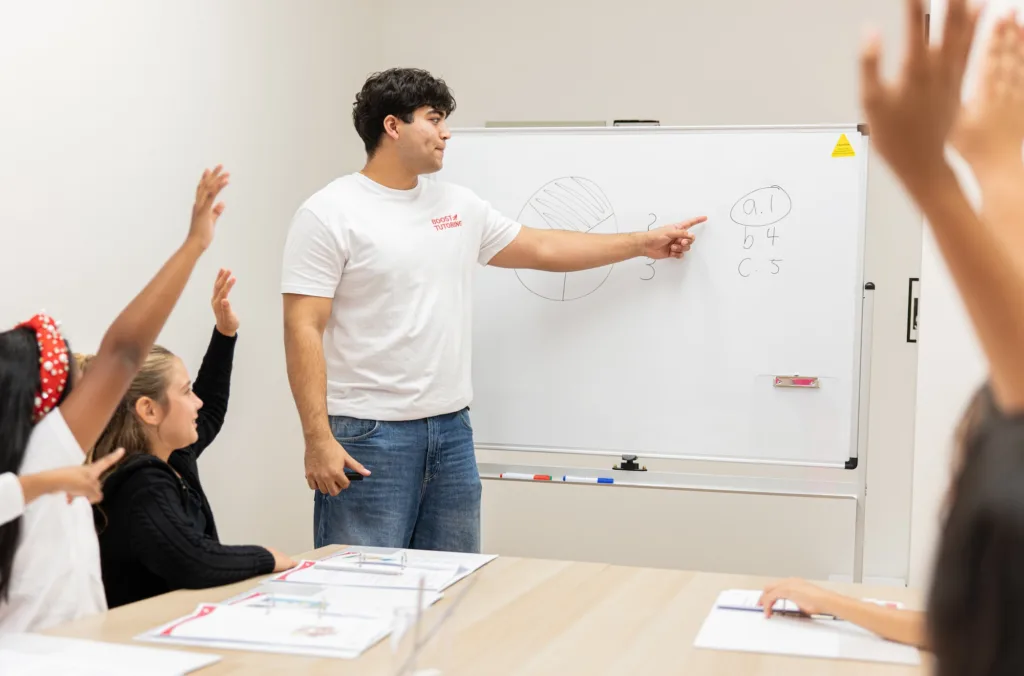
This is why every Boost session opens with five minutes of Prime skills work, such as times tables and mental maths, before the tutor moves into curriculum content. Students at Boost Tutoring Castle Hill and the Beaumont Hills centre get this in small-group maths support, with the same tutor each week.
None of it is about racing ahead or promising a mark. The aim is foundations steady enough to make a word problem a reading job, and the guessing stops.
If you can’t tell whether your child is misreading the question or missing the maths underneath, a free assessment with Boost Tutoring Australia sorts that out. It shows what’s already secure and the exact step where things fall apart, which gives home practice something specific to aim at.
Book a free academic assessment and see exactly where your child’s foundations sit