
This essay has more markup than usual, none of it circling a misspelled word. Somewhere between the question and the conclusion, the argument got lost, and your child isn’t sure why. Real essay writing tips focus on the argument itself: they turn a bare question into a position a child can actually defend. Spelling comes later, once the reasoning already makes sense on its own.
What Actually Makes Essay Writing Hard
Essays test more than task comprehension. A child has to shape ideas into order and write for a reader who never saw how the thinking began, which no spelling test can catch.
What the Question Is Actually Asking
Skip past a word like discuss, evaluate or persuade, and the whole response drifts: a child ends up answering a question that was never actually set.
A vague prompt becomes a clear goal once the task is named before any writing starts: what position to take, and what the answer must prove.
Building an Argument Before the First Sentence
An essay needs a main point before it needs an opening line, then two or three reasons that support it and evidence behind each one.
Purpose, audience and structure matter as much to strong writing as correct sentences do, based on a 2022 comparison of Australian and American writing curricula by Zammit, Rhodes and Milby.
Families looking for broader English tutoring support can benefit from the same focus on building ideas before turning attention to sentence-level corrections.
How to Help at Home Without Taking Over
Parents rarely need to write the essay to help with it. Most of the real support happens before the first sentence and after the last one.
Start With Planning, Not the First Sentence
Spelling and grammar take up most classroom writing time. Planning and revising barely get a look-in, and that gap is where home support does the most good.
The same pattern appears in a 2022 survey of 310 Australian primary teachers, published in the journal Reading and Writing.
A plan comes before the first sentence: what the essay needs to say, and in what order.
An hour polishing an opening line changes little. A rough list of two or three points does more for the final draft.
Ask Questions Instead of Rewriting the Sentence
A muddled paragraph is rarely fixed by rewriting it. The better move is working out what it’s trying to show, or whether a piece of evidence supports the point being made.
A child who works out the fix themselves tends to remember it. A direct correction rarely lasts nearly as long.
Build Small Revision Habits
Revising an essay is different to proofreading one, and children rarely learn the difference unless someone shows them.
Proofreading fixes spelling. Revising asks harder questions than proofreading does. Does the introduction answer the question? Has each paragraph earned its place, and is the evidence explained instead of included?
Fixing one paragraph properly beats a scattershot pass at every sentence in the essay.
A child asked to fix one unclear sentence usually manages it well. A whole essay marked up in red usually shuts them down instead.
Parents who are unsure how much help is useful can also read our guide on whether Hills parents should help with homework.
When Does a Child Need More Support Than Home Can Give?
Most children reach a point where home support alone isn’t quite enough, regardless of how capable the parent is.
Some parts of essay writing need more structured teaching than a kitchen table can offer.
Signs Worth Paying Attention To
Twenty minutes can pass before some children get a single word onto a blank page. Others submit essay after essay carrying the same feedback, regardless of what gets corrected.
A child who explains a topic clearly out loud but freezes when asked to write about it is usually showing a real skills gap rather than low effort.
Families can also explore how to know if your child needs a tutor in Castle Hill when deciding whether additional support may be useful.
What Good Support Actually Looks Like
Spelling and punctuation still dominate classroom time, well ahead of the advanced essay writing skills that matter more: organising ideas, building an argument.
The same imbalance shows in classrooms, according to a 2024 study of Queensland Grades 4 to 6 teachers in the International Journal of Educational Research.
That gap is usually what sends families looking into tutoring in the first place.
It’s worth reading why many Hills District parents choose an English tutor in Castle Hill before assuming extra homework will close it alone.
How to Know Your Child’s Essay Writing Is Actually Improving
Real progress rarely shows up as a sudden jump in marks. It shows up as a child who can explain, unprompted, what a paragraph is meant to prove.
A first draft with some shape to it says more than one long slab of ideas.
Feedback that shifts off spelling and punctuation onto structure and argument is a sign the basics are sorted.
How Boost Tutoring Approaches Essay Writing
The same process runs for every student at Boost Tutoring: assess where the gaps actually sit, plan a path around them, coach the skill directly, then review what’s changed.
Essay writing gets more time on planning and argument. The spelling and grammar most home practice covers stays part of it, alongside revision.
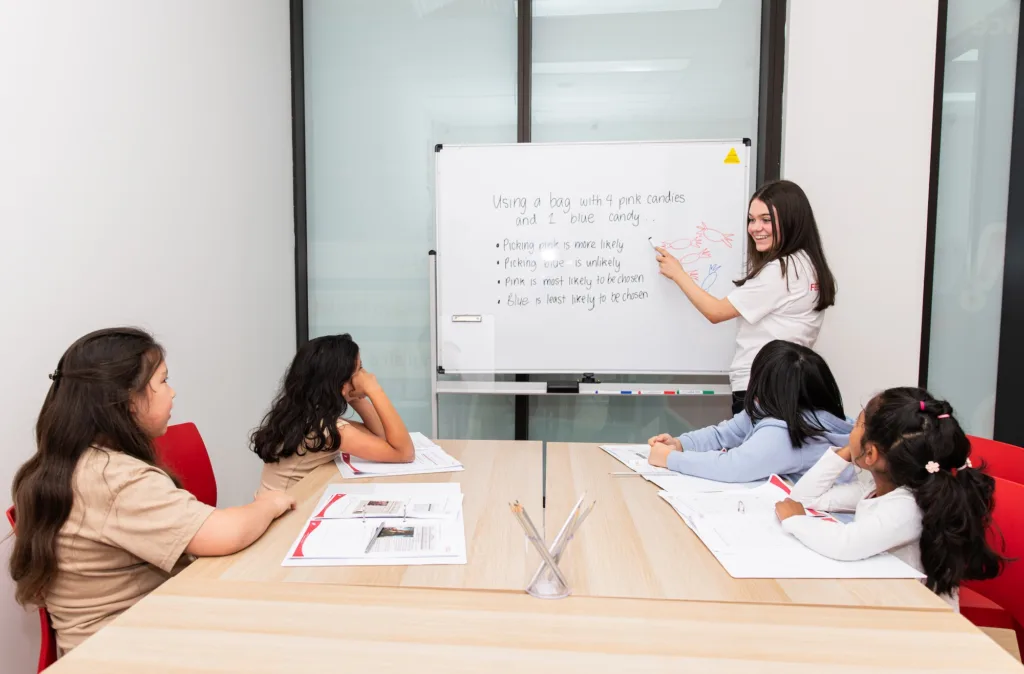
Six to eight students meet in each group, with the same tutor every week and a daily worksheet aligned to the NSW syllabus. That keeps sessions consistent.
Maths and English tutoring at the Castle Hill centre spans Kindergarten to Year 10.
Younger students come through primary school English tutoring in Castle Hill, built around the same planning-first approach.
Families interested in this learning format can also explore small group tutoring in Castle Hill.
Frequently Asked Questions About Helping Children Write Better Essays
Hills District parents raise the same essay writing tips questions again and again about supporting a child at home.
How can I help my child write a better essay at home?
Start with planning rather than the opening sentence. Ask your child to list their argument and evidence first, then check the plan makes sense before any writing begins.
At what age should children start learning essay writing?
Structured paragraph writing starts around Year 3 or 4 in most NSW schools. Full essay structure builds through upper primary, then develops steadily across Years 7 to 10.
Families supporting younger students may also find our guide to Year 3 tutoring in Beaumont Hills helpful.
How often should my child practise essay writing?
Little and often works better than a long session every so often. One planned paragraph or a single revised passage stops the skill from fading.
Is tutoring worth it if my child struggles with essays?
Often, yes, when a term of feedback hasn’t shifted despite home effort. Tutoring supplies structured practice that’s hard to keep up alone, especially with planning and argument.
Families comparing different approaches can also explore the best tutoring options in the Hills District.
How much does English tutoring cost in Australia?
No fixed figure exists nationally, since providers price differently by location and session load. Contact a provider directly, such as Boost Tutoring in Castle Hill, for current pricing.
Better essay writing tips always come down to the same thing: teaching a child to think an argument through, one clear question at a time.
If Your Child Still Struggles With Essays, More Homework Isn’t the Answer
Extra worksheets won’t fix an essay missing an argument.
We start with a free assessment, so you know where your child’s writing needs support, whether that’s planning and structure or the confidence to get ideas onto the page, before anything ongoing begins.
Book a free assessment and find out what changes once the right support is in place.