The report card reads “meeting expectations.” At the kitchen table, though, a simple worksheet stretches into forty minutes, an eraser worn thin, and a child muttering, “I’m just bad at maths.”
A primary maths tutor Castle Hill families choose has a bigger job than tonight’s homework sheet. That job starts with a simple question: where did understanding slip, and what support closes the gap?
A shaky grip on early number skills can follow a child for years, which is why a persistent struggle deserves attention now. Early support becomes a lasting foundation.
What Maths Foundations Should Primary School Children Build?
Building genuine foundations means more than speed. It means a child who understands what a number represents, feels calm reaching for it, and can explain how they got there.
Number Sense, Fluency and Mathematical Confidence
Number sense starts small: knowing seven is more than five without counting fingers, or that halving eighty beats adding forty twice. A child with strong number sense reaches for the shortcut naturally.
Picture a child who has times tables memorised cold, yet freezes the moment a question changes shape. Fluency without real understanding cracks exactly there, the instant a familiar question wears an unfamiliar face.
Problem-Solving and Mathematical Reasoning
A worded problem that hides its own operation is where reasoning actually gets tested, forcing a child to work out what the question is really asking. Schools weigh this heavily now, well beyond simple recall.
It also shows in smaller moments: splitting a pizza fairly, working out change at the shops, or spotting a pattern repeat in a times table. The same reasoning carries into every classroom test.
When Does a Child Benefit From Extra Maths Support?
Struggling with one topic for a fortnight is normal. A pattern that holds term after term is the one you shouldn’t wait out.
Signs Your Child May Need More Individualised Help
A concept that was solid last term but has quietly gone shaky is one of the clearest signs. So is a child who stalls on homework or goes quiet rather than explain.
Regular practice that isn’t closing the gap points the same way. A child who insists they just hate maths is often protecting against a foundation gap rather than showing poor attitude.
A smaller group of children go further still. Interest in school fades more broadly, well beyond maths, and that points to a different conversation entirely.
Parents who are still unsure whether a pattern has developed can also explore how to know if your child needs a tutor in Castle Hill.
Why Early, Targeted Support Can Matter
Early number strength predicted better maths results into mid-primary school. That link held across more than 1,200 children tracked from kindergarten to Grade 1, in a 2025 study in Learning and Individual Differences.
The researchers also found that early numeracy gaps don’t close by themselves once they appear. Screening matters while a gap is still small, before it grows across the following years.
Families supporting children in the early primary years may also find our guide to Year 3 tutoring in Beaumont Hills useful.
How Can Primary Maths Tutoring Build Stronger Foundations in Castle Hill?
Strong tutoring rarely resembles more homework piled onto an already long day. It looks more like careful diagnosis, precisely locating where your child’s understanding has worn thin.
Look for Personalised, Targeted Maths Support
Not every stuck child needs the same fix. A tutor who maps what a child already knows, then shapes each explanation around how that child learns, gets further.
Once schools matched instruction to the actual gap instead of running one-size-fits-all lessons, real gains followed, according to the NSW Department of Education’s 2024 numeracy evaluation.
Families considering different forms of support can also learn more about maths tutoring and how structured help can target specific learning gaps.
Make Maths Support About Confidence as Well as Results
Confidence grows when your child works through a problem alone first, mistakes included, rather than watching someone else demonstrate the right method every time.
A wrong answer explained clearly is worth more than a right one guessed. The confidence piece is often the harder half of the job, more than the arithmetic itself.
For children whose confidence has already been affected, our guide to why students fall behind in maths and how to catch up explains how small gaps can develop into broader difficulties.
How to Know the Support Is Working
You’ll usually notice the signals before the report card does: less negotiation over homework, your child attempting the hard question, or explaining a method without being asked.
Academically, the shift tends to show first in speed and willingness. Test scores are usually the part that follows a few weeks later.
Parents can also explore why structured weekly tutoring beats casual help when considering how consistent support can affect long-term progress.
Where Can Castle Hill Families Find the Right Primary Maths Support?
Location matters less than fit. The real question is whether an approach fits what your child needs right now, wherever the centre happens to sit.
What to Look For in a Primary Maths Tutor in Castle Hill
No single method suited every child. That is the conclusion of a 2023 systematic review of 34 studies on maths learning difficulties, published in the International Journal of Education and Literacy Studies.
What should a good tutor explain in plain terms? How they spot a gap, what the plan is to close it, and how parents hear about progress through the term.
Families comparing local options can also read what to look for in maths tutoring in Castle Hill.
Why the Right Fit Matters
A tutor’s job is to work alongside the classroom, keeping what your child needs now in view while preparing them for what NSW maths expects next.
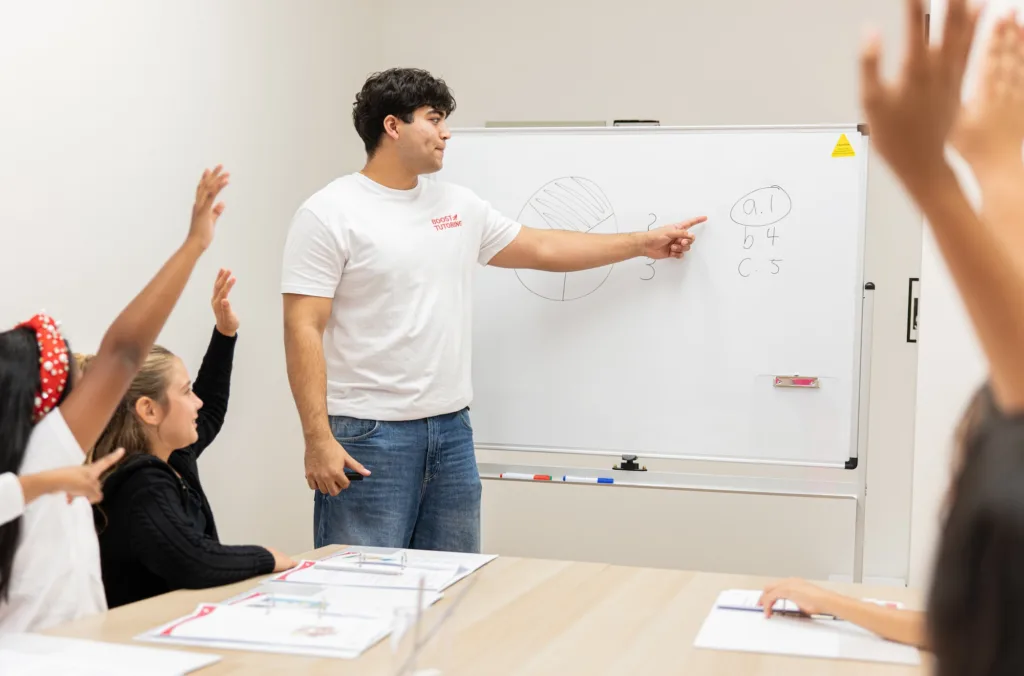
At Boost Tutoring Australia, we begin with an assessment, shape a plan around what it shows, then coach in small groups of six to eight with the same tutor every week.
Our Castle Hill centre reviews progress through the term and runs the full K–10 Maths and English program, with a daily home worksheet included.
Families can also learn more about small-group tutoring in Castle Hill and how smaller groups can support more individual attention.
Primary Maths Tutoring in Castle Hill: Frequently Asked Questions
A few quick answers to the questions Castle Hill parents ask most before booking that first session, the ones that usually decide whether to wait or act now.
How often should a primary school child have maths tutoring?
Weekly sessions are usually plenty, enough rhythm to build momentum without swallowing the whole school week. Push to twice a week only once a gap has properly settled in.
Is maths tutoring worth it if my child is already meeting classroom expectations?
Yes, and this one’s usually the easier ask. Extending a child who’s coping fine tends to build confidence and depth rather than close a gap.
What age should a child start maths tutoring?
There’s no set age, since what actually starts the clock is a gap or a dip in confidence, and either can show up as early as Kindergarten or as late as Year 6.
How can I tell whether my child needs a maths tutor or simply more practice at home?
Extra practice at home for a few weeks and no real shift? That usually means repetition alone has reached its limit.
For more signs to consider, read our guide to 10 signs your child needs a maths tutor in Castle Hill.
Don’t Wait for a Maths Gap to Become a Confidence Gap
By the time a maths gap shows up on the report card, quiet, steady support has usually already closed it, one piece at a time.
If a gap has been sitting there a while, a free assessment with a primary maths tutor Castle Hill families trust shows exactly what closing it would take.
Get in touch with our Castle Hill centre to find out what your child’s foundations need next.